
Tracked Mini Dumpers (Track Dumpers) in Canada
ArcPath’s published tracked mini dumper model is the ATD-800, with a rated payload of 800 lbs (363 kg). Use its specifications as a reference for attachment and parts enquiries.
For soil, aggregate and construction materials, a tracked dumper is a material-handling option to assess alongside a power wheelbarrow. Compare the specific machine specifications with your load, ground conditions and access route.
- ATD-800 rated payload: 800 lbs (363 kg)
- Published width: 28.7 in (729 mm)
- Hydrostatic drive with individual control levers
| Rated payload | 800 lbs (363 kg) |
|---|---|
| Published width | 28.7 in (729 mm) |
| Drive system | Hydrostatic |
| Travel | Two-speed tracking |
| Controls | Individual control levers |
| Maximum operating slope | Not stated in published specifications |
Published specification reference; these figures describe the ATD-800, not other dumper or wheelbarrow models.
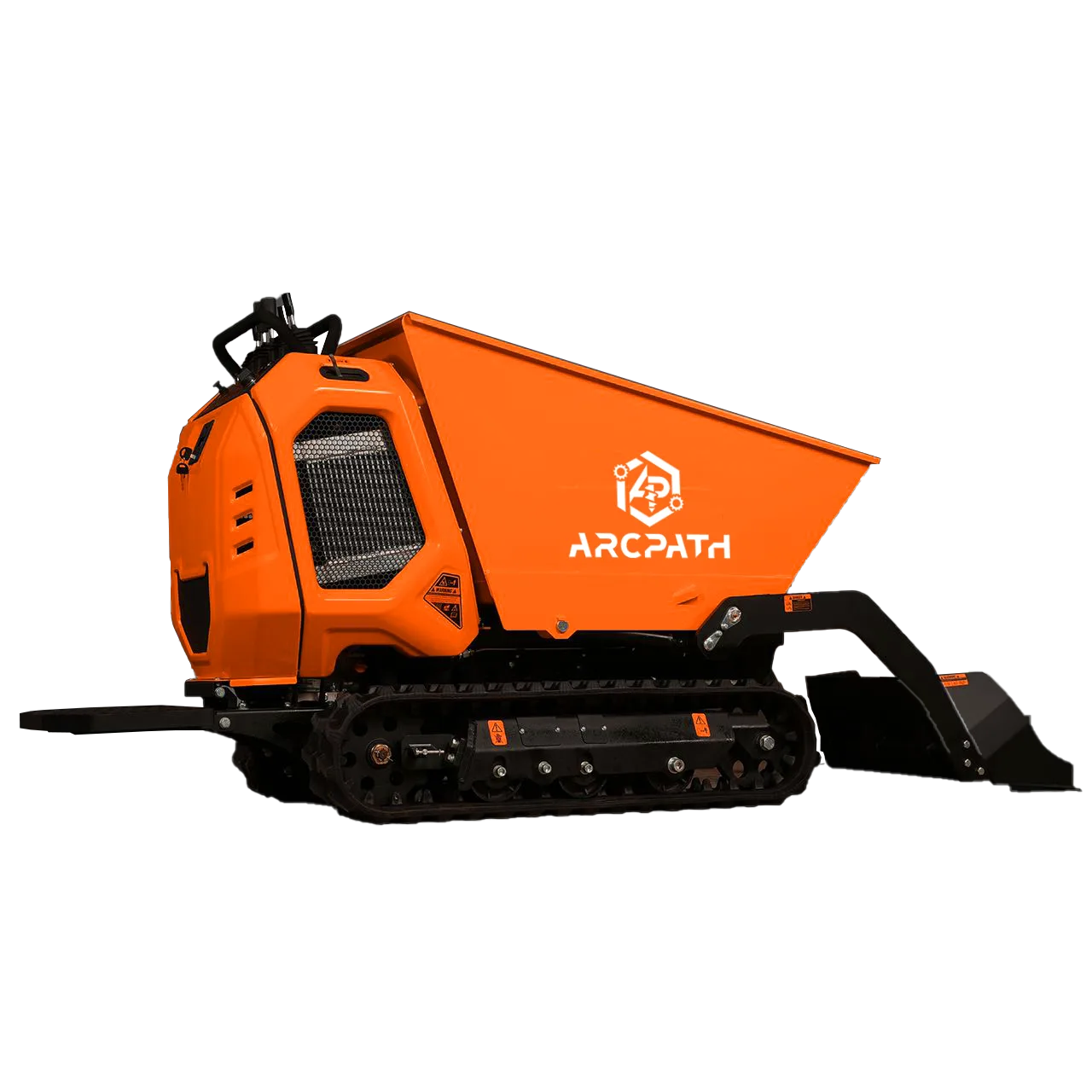
ATD-800
Track Dumper
The ATD-800 is a high-capacity track dumper designed for efficient material transport on construction sites. Combines power, reliability, and durability for demanding applications with exceptional traction and stability.
Payload Capacity
800 lbs (363 kg)
Engine
Honda GXV390, 13 HP
Width
28.7 in (729 mm)
Drive System
Hydrostatic
Travel Speed
Two-Speed Tracking
Controls
Individual Control Levers
Key Features
Why Choose ArcPath Dumpers
High Capacity
Exceptional payload capacity for demanding material transport applications.
Reliable Operation
Durable hydraulic systems and track design for consistent, dependable performance.
Superior Traction
Advanced track system ensures stability and control on challenging terrain.
Tracked dumper, electric wheelbarrow and wheeled dumper: site uses
Start with the intended load and route rather than the equipment name. Check each machine’s own specifications; the ATD-800 figures below do not describe other mini dumpers or power wheelbarrows.
Tracked dumper: soil and aggregate on construction sites
Tracked dumpers handle soil, aggregate and construction materials. The ATD-800 figures above identify that tracked carrier for attachment and parts enquiries; they do not describe electric wheelbarrows or wheeled dumpers.
Electric wheelbarrow: battery-assisted material transport
Makita documents a power-assisted wheelbarrow for material transport on job sites, with interchangeable flatbed and bucket arrangements. For a parts enquiry, identify the actual carrier and load-carrying configuration; an electric power source does not establish payload or slope limits.
Wheeled dumper: transport around construction sites
Wacker Neuson describes wheel dumpers for jobsite tasks, with an articulated pendulum joint for manoeuvrability and off-road work. Identify the model and chassis configuration for a parts enquiry; these characteristics do not establish ATD-800 compatibility.
Payload and access
The published ATD-800 payload is 800 lbs (363 kg) and its width is 28.7 in (729 mm). Compare those figures with the load you intend to carry and the narrowest part of the route. Check the power wheelbarrow’s rated capacity and width separately.
Ground conditions
The published ATD-800 specifications list hydrostatic drive and two-speed tracking. For landscaping or site preparation, assess the loaded route, turning space and ground conditions before choosing either machine.
Slopes
The published ATD-800 specifications do not state a maximum operating slope. Confirm the permitted gradient and loading instructions in the machine’s operator manual before planning work on a slope; a tracked undercarriage is not a slope rating.
Use references (retrieved 2026-11-16): Makita wheelbarrow · Wacker Neuson wheel dumpers
Frequently asked questions
Which tracked mini dumper model does ArcPath document?
The published model is the ATD-800, with a rated payload of 800 lbs (363 kg). This page provides a specification reference for attachment and parts enquiries.
How should I compare a mini dumper and a power wheelbarrow?
Compare the rated payload, machine width and intended route for the specific machines. Use the ATD-800 specifications as a reference, and check the power wheelbarrow’s own specifications separately.
How wide is the ATD-800 tracked dumper?
The published width is 28.7 in (729 mm). Measure the narrowest opening on your route and check the clearance needed for operation before planning access.
What is the ATD-800 maximum operating slope?
A maximum operating slope is not stated in the published ATD-800 specifications. Confirm the permitted gradient and loading instructions in the operator manual before planning slope work.
Do electric wheelbarrows and wheeled dumpers share the ATD-800 specifications?
No. The ATD-800 figures describe the tracked dumper documented here. Electric wheelbarrows and wheeled dumpers have their own model specifications; the power source or undercarriage name does not establish payload, access width or permitted slope.